How We Check This Casino in Full
Every verdict on Shuffle Casino comes out of this method. We read the operator terms end to end, look the licence number up in the regulator own register, pull catalogue figures from the operator public API instead of its marketing, and check the fairness commitment by rotating a seed pair and hashing what it reveals. Scores run from 1 to 10. This page walks through the process, including what it cannot reach.
- Where checking happens
- The operator own documents, register and API
- Scoring scale
- 10, 5 or 0 on 16 criteria, in 3 groups
- Evidence accepted
- Quoted clauses, API responses, register entries, rotated seeds
- Checks on record
- Known limits
- 3, each printed on the page it affects
- Audience
- Adults aged 18 or over
Table of contents
The Documents Come First
Checking starts in the operator own paperwork, not on its marketing page. We read the terms clause by clause, query the public catalogue interface for figures the storefront summarises, and look the licence code up in the register that issued it.
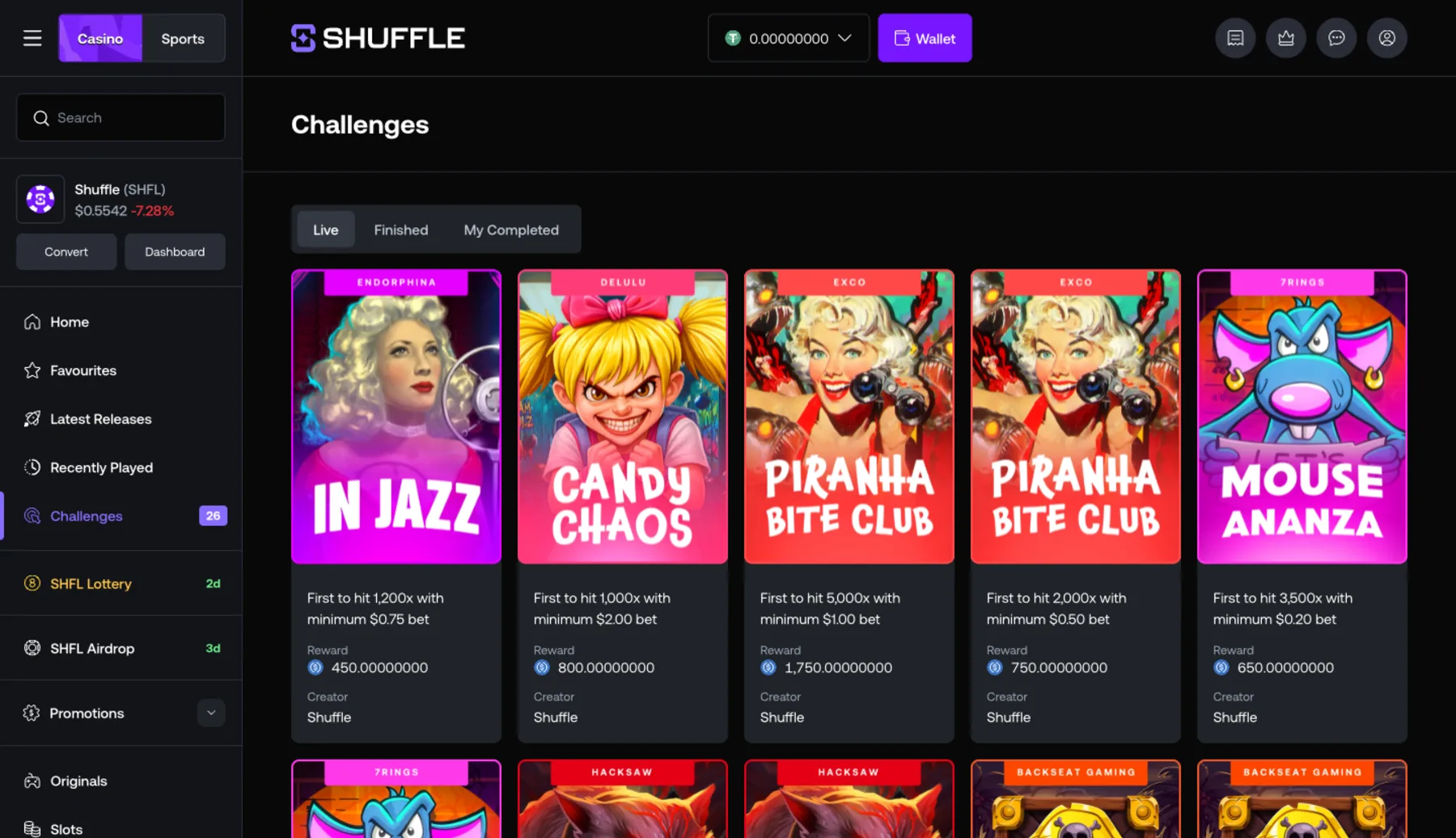
Nothing gets paraphrased. Every figure on this site is quoted in the wording its source used, with the date we read it. The catalogue query is the clearest example of why that matters: the storefront advertises over 15,000 games, and the operator own unauthenticated GraphQL endpoint answered with a totalCount of 4,382 on . Both numbers come from the same company. We print the machine-readable one and name the gap.
In Short, Before You Trust a Score
Here's what a score on this site is worth: it's the product of documents, API responses and register entries, and nothing else. We've never deposited at this casino, never staked a cent and never asked it for a withdrawal, and you'll see that limit repeated wherever it matters.
That limit is deliberate. A reader who wants to know how a slow payout feels with their own money on the table will not learn it here, so the score speaks to what the operator publishes and whether it holds up, which is a narrower question than whether the casino is any good.
What stands behind a sentence beginning with “we checked” is a dated artefact: a clause quoted verbatim, a JSON response, a register line, or a seed we watched rotate. Each of the 19 pages carries the date of its own last check, because an operator revises terms without telling anyone.
What a Reader Can Repeat Without an Account
Four of these checks need no account, no deposit and no download. Three of them need nothing but a browser.
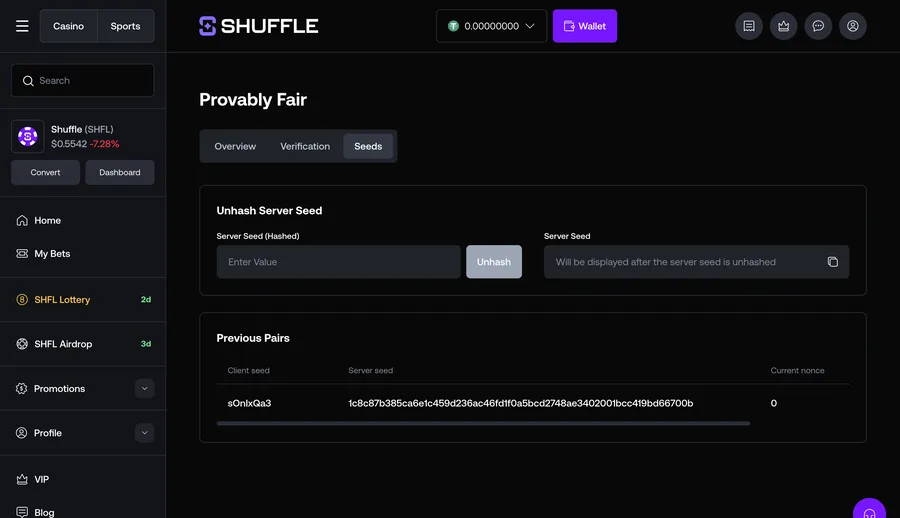
- Open the fairness panel and copy the hash printed for the next server seed, before anything else happens.
- Change the client seed, which rotates the pair, then hash the revealed server seed as an ASCII string and compare it with the hash you copied.
- Query the public catalogue endpoint and compare its totalCount with the figure on the storefront.
- Look the licence code up in the Curacao register file for the month you are reading, and note the dates on the entry.
The first two take about five minutes and prove the commitment, not the outcome. That distinction is the whole point, and the legitimacy review works through it line by line.
What This Method Cannot Show
The method has a ceiling, and this is the honest shape of it. Reading a document tells you what a company has committed to, never what it does when a withdrawal is held in review, so the pages that matter most to your money rest on the operator own wording plus other people complaints, not on our experience of being paid.
The checks of staked nothing at all: no round was played and no withdrawal was requested, so no figure on this site describes what our own money did. Those are observations with dates on them, not statistics, and the page says so wherever they appear.
What Our Fairness Check Reaches
We closed this one ourselves, and it is worth being precise about what closed. On , in a logged-in account and without placing a single bet, we copied the hash the panel published for the next server seed, rotated the pair, hashed the revealed seed as an ASCII string, and got a match. Then we did it again on a second, independent cycle. The operator own worked example reproduces too: client seed abc, server seed def, nonce 1 gives the float 0.43053962965495884, which is Dice 43.05 and Limbo 2.29.
That proves the commitment, not the outcome. A matching hash shows the server seed was fixed before the round, which is exactly what the scheme promises and no more. It says nothing about whether any individual result was fair, and two of the Originals, Crash and Slide, run a different pre-commit scheme that a single player cannot close alone.
The laboratory side is thinner. iTech Labs issued a certificate to Natural Nine BV dated , published as a PDF on the laboratory own domain, and it names scaling tests for eleven titles, which leaves six of the seventeen Originals outside the tested list. The PDF carries no certificate number, no GLI or BMM certificate is published anywhere, and the testing was carried out against UK Gambling Commission standards although the operator is licensed in Curacao. That is not a UK licence, and anyone presenting it as one is misreading the document.
What a Reader Is Left With
What is left is an audit a reader has to take on trust, which is weaker than a proof they could run themselves. The gap gets printed as a gap rather than smoothed over.
So the two assurances appear side by side instead of merged. The legitimacy review walks through the same distinction end to end.
Sourced Numbers Quoted as Printed
Every number is sourced before it is printed, and the date of its check travels with it. Returns, stake limits and licence details come only from the client, the operator game page or a regulator register, and each figure keeps the shape they gave it.
The operator publishes a house edge for every title through its catalogue interface, which is more than most casinos publish at all. A storefront summary is a different kind of statement from an API response, so the pages keep the two apart rather than blending them into one number.
The same rule governs the catalogue count. Adding up gamesCount across the 48 providers gives 5,174, the catalogue totalCount gives 4,382, and the sitemap carries 10,278 game URLs including withdrawn titles. Three figures, one company, and they must never share a table column. We invent no payment methods, bonuses, licences or multipliers, and the return reference page is the model for this rule.
Honest Cons from Every Testing Round
Every page names its downsides. Cons are mandatory on every page that carries a verdict. A testing round that finds nothing wrong was never a test, so the drawbacks are written before the verdict.
Every page carrying a verdict includes a real downsides section. Every page that carries a verdict has a real downsides section and, where it applies, a named alternative the editors would pick instead.
The drawbacks stay specific: a buy that quietly costs you return, a ceiling that cuts a bonus round short, a volatility label the game gives itself and nobody else agrees with, an operator whose terms shut whole states out of this studio catalogue. We also name who should avoid the game, and that warning sits before the sponsored button instead of after it.
Scoring on 16 Criteria
An operator score is a weighted average of 16 criteria in three groups, trust, games and money, and each criterion scores 10, 5 or 0. The middle mark carries the unusual meaning: 5 means the operator publishes nothing on that point. So a score here measures how much of itself a casino is willing to put in writing, which is not the same question as whether it is a good casino.
The engine calculates it from the operator dossier rather than an editor picking a number, and a criterion we could not verify stays at 5 instead of being guessed either way. The figure appears in the first 100 words of a review and again in the verdict, so the result is never buried.
| Criterion | What is tested | Evidence accepted |
|---|---|---|
| Trust | Licence status in the register, the number quoted and linkable, the operating company named in the terms, restricted countries published | Register entry by number, read in the monthly file; the terms themselves |
| Games | Whether a title is confirmed in the lobby, bet range, the return or house edge the operator states, any win cap | The public catalogue endpoint, queried on a dated pass |
| Money | Bonus wagering and expiry, withdrawal timings and minimums, payment methods, the KYC trigger, mobile access | Clause-by-clause reading of the published terms, quoted verbatim |
| Fairness commitment | Whether the server seed really was fixed before the round, as the panel claims | Two independent seed rotations, each revealed seed hashed and matched against the earlier commitment |
| Disclosure | Whether every number traces to a source a reader can open | Named source beside each figure on the page |
What the API and the Registers Provide
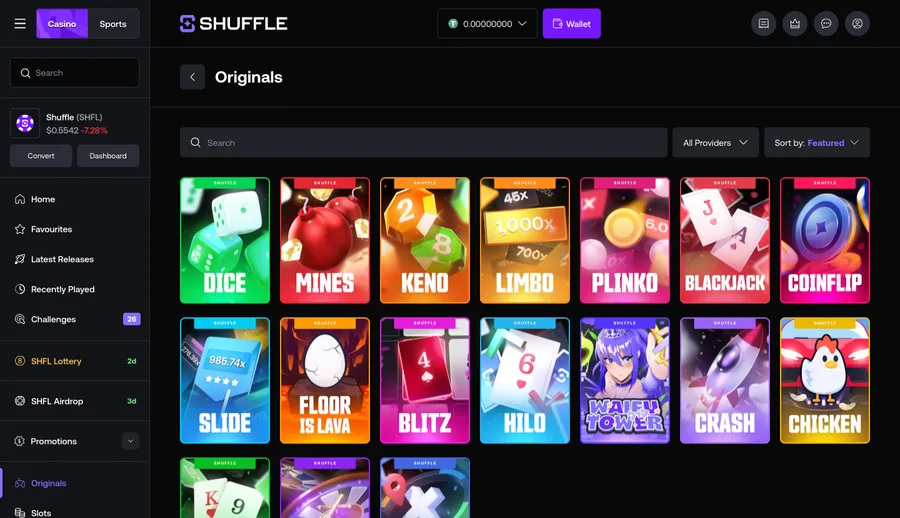
The catalogue endpoint answers without a login, which is why it is the backbone of the games group: 4,382 titles, 48 providers, 4,205 slots, 84 live tables, 42 game shows and 17 in-house Originals, each with a house-edge field. Live tables come from Evolution with 46, Pragmatic Play with 23, Maxxi Labs with 9 and 155.io with 2.
The register supplies the other half, and it has a history worth reading. Licence OGL/2024/1337/0628 sits against Natural Nine BV and company number 160998, issued and listed with an indefinite term in the file dated , though earlier files in the same monthly series show the entry changing before it settled. Competitors quote the first date they find as though it were the current one.
Three footer policies publish a heading and nothing else. We checked twice, including after waiting for client-side rendering: /info/deposit-bonus-terms, /info/affiliate and /info/airdrop-3-terms each return 1,122 characters of shell text against 1,451 for the populated licence page, and all three are byte-identical to one another. The first of them is the document the promotional pages point to. We report that with its date and method, not as a verdict on anyone good faith.
Which Criteria Decide a Score?
Our criteria are fixed before a game is opened, and they stay fixed whatever the result turns out to be. To verify a claim, the editors go back to the document that carries it, then quote the wording they find there rather than their impression of it.
Every page includes the source beside the figure it carries. Readers can follow the same trail, so they can open a document themselves, and you can disagree with a score while still trusting the numbers under it.
Where the Return Figures Disagree
The return figures describe different things, so the table keeps each one beside the document that prints it, with no averaging. A reader can then see which figure applies to the way they actually play.
| Document read | Return it prints | What the method does with it |
|---|---|---|
| Operator catalogue API | A house edge per title | Treated as the only published return figures for this casino |
| Provider gamesCount, summed | 5,174 across 48 providers | Printed beside the catalogue figure, never merged with it: the same company reports both |
| Game sitemap | 10,278 game URLs | Not used as a catalogue count, because it includes withdrawn titles |
What Else the Client States Outright
Four more values come straight from the operator own surfaces, copied exactly as they appear. Nothing in the table is inferred from a third party.
| Field | Value as shown in the client |
|---|---|
| Originals with a demo mode | 13 of 17; Dice, Mines, Plinko and Crash have none |
| Lowest published house edge | 0.52% on Blackjack, which is 99.48% back |
| Highest published house edge | 2.7% on Roulette, which is 97.30% back |
| In-house games the API returns | 17, one more than the storefront table lists |
Operators Checked on Official Sites
Operators are checked on their official sites and on nothing else. A casino page is tested the same way a game page is: the editors open the operator game page, read the terms, then look the licence up in the regulator register.
Everything an operator prints goes down exactly as found. Betting limits, demo availability, deposit and withdrawal timings, mobile access and bonus rules go down in the wording the operator used. Aggregator claims stay out, and a casino that resists verification simply gets no page here. Compared to a ranked list that is slower, though it means no operator here is judged against a rival instead of against its own documents.
How Licence Regulation Is Confirmed
Regulation is confirmed by number instead of by badge, and the monthly file matters as much as the number. Three consecutive Curacao register PDFs show this entry changing dates and status before it settled on an indefinite term, so a competitor quoting the first date it finds is quoting a superseded line.
- Licence status and number, read in the regulator register on the test date.
- Demo availability and stake range, read on the operator game page.
- Withdrawal timings, minimums and identity-check triggers, read in the operator terms.
- Bonus rules for this game, read in the bonus terms instead of the banner.
- Support channels and mobile app notes, taken from the operator help pages.
The operator pages say not confirmed wherever a figure resisted verification. That wording is deliberate, because a gap a reader can see beats a number nobody can trace.
Terms This Method Uses
- Recorded session
- A demo run written down round by round, with the stake, the running total and the final result of each decision.
- Certified generator
- A generator audited by an outside laboratory. Here that is one iTech Labs certificate covering eleven titles, with no certificate number on it.
- Operator-selectable return
- One of several certified versions of the same game a casino may run, which is why two lobbies can pay differently under one name.
- Not confirmed
- What a page prints when no provider page, operator term or regulator register states the figure in question.
What the Record Actually Holds
The record holds artefacts, not a bankroll. Nothing in it was staked, which is why none of it describes a payout, and each entry carries the date it was captured.
| Part of the record | Date | What it holds |
|---|---|---|
| Seed rotations | Two independent cycles: the published hash, the revealed server seed, and the SHA-256 match for each | |
| Catalogue query | The unauthenticated GraphQL response: totalCount 4,382 across 48 providers, with the per-title edge field | |
| Register reading | file | Licence OGL/2024/1337/0628 against Natural Nine BV and company number 160998, listed indefinite |
| Empty-policy check | Three footer policies at 1,122 characters each, byte-identical, re-checked after client-side rendering |
3 Types of Testing Limit, Compared
The complete list of testing limits runs to 3 entries, and each one shapes every score here. Readers who weigh a verdict should read them before the verdict itself.
| Limit | Why it exists | What happens instead |
|---|---|---|
| No real-money play | No stake was placed and no withdrawal requested at any point | Withdrawal timings are quoted from the operator terms, never measured |
| Short sessions | Ten rounds cannot measure a long-run average | The return is quoted from the developer page, never computed here |
| No round-level proof | This title exposes no seed or hash a player could re-check | Fairness is reported as a certified audit, not as something we verified |
Does a Demo Round Prove Anything?
A demo round proves the mechanics, and it proves nothing about a long-run average. That is why the return is quoted from the developer instead of measured here.
Readers can repeat any round themselves in about 10 minutes. They will meet the same growth curve, the same limits panel and the same fairness panel our session recorded.
Recap: The 3 Limits of This Testing Method
Three limits shape this testing method, and the page names each out loud. First, testing happens in the demo instead of with real money, so withdrawal speed is quoted from the operator terms. Second, ten rounds say nothing reliable about a long run, which is why every return figure comes from the developer rather than from us. Third, a finished round can be rebuilt but the commitment behind it cannot, so half the fairness claim is proved here and half is reported.
Everything else on this page recaps in a sentence or two. Demo play comes first, the fairness gap is named rather than papered over, sourced numbers are quoted as printed, cons sit beside the verdict, a game verdict scores 10 on 5 criteria while an operator score weighs 16, and operators are checked on official sites. All testing is done by the analyst who signs each page, and every page here is written for adults aged 18 or over.
Deposits and identity checks stay on the operator's own secure site.
Related Reading on This Casino
More on this game, from the same section first: