

How to Deposit at Shuffle Casino, Step by Step
In short: Funding Shuffle takes crypto or, in Canada, Interac in Canadian dollars with a $5 minimum and $10,000 maximum per transaction. The cashier opens only after an identity form asking for your name, date of birth and address.
The deposit itself is the easy part. What catches people is the screen before it, because the wallet does not open until you have handed over identity details, and the storefront gives no hint that this is coming. Clearing that step first turns funding into a two-minute job.
- Casino:
- Shuffle (shuffle.com), an online crypto casino and sportsbook operated by Natural Nine BV
- Type:
- Casino and sportsbook
- Published returns:
- There is no single return-to-player figure for a casino, and any page that states one is wrong.
- Published ceiling:
- Shuffle publishes no maximum win for its casino.
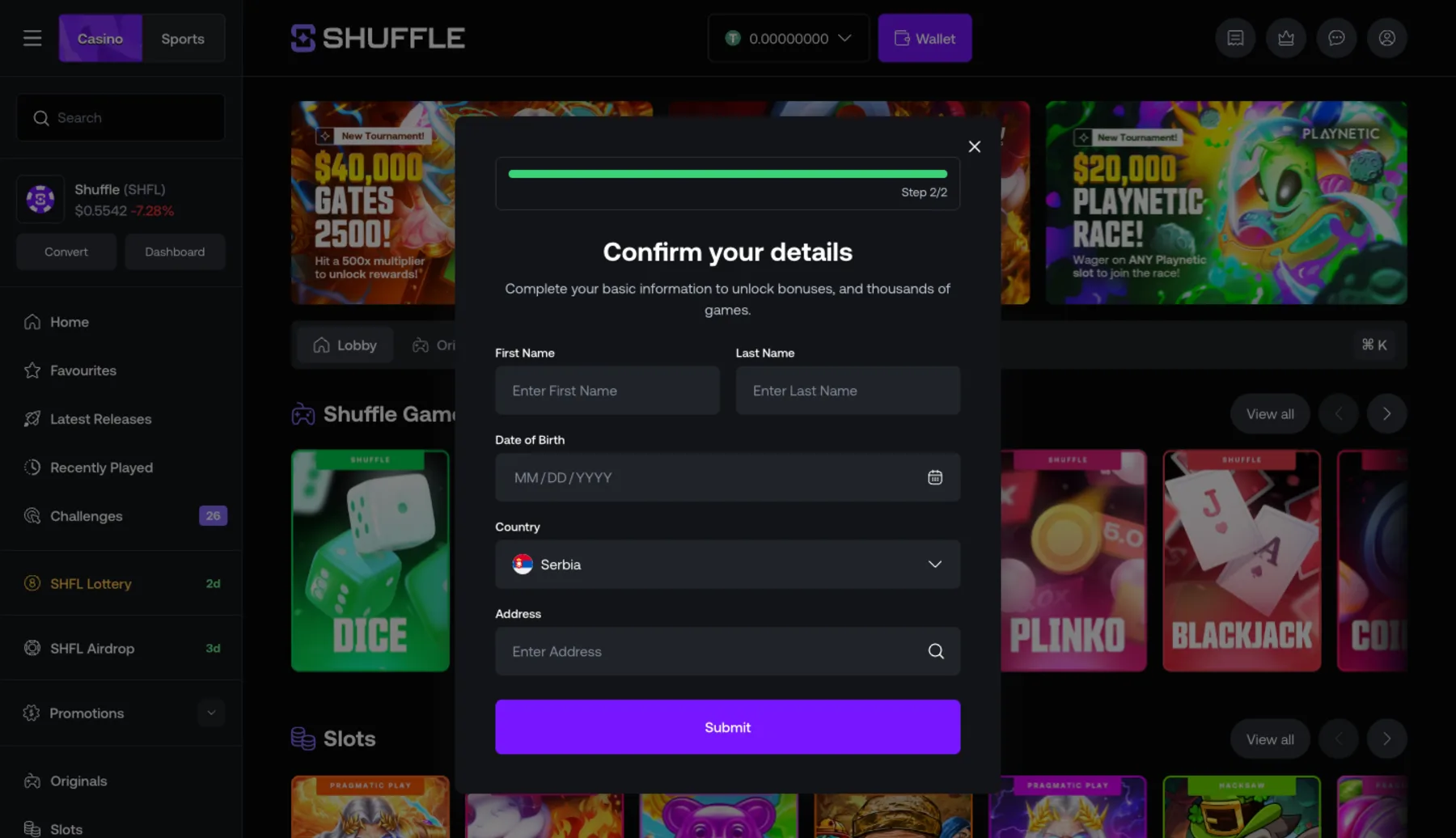
Note: Shuffle accepts deposits in BTC, ETH, LTC, SOL, USDT and its own SHFL token, and Canadians can fund in Canadian dollars through Interac with a $5 minimum and a $10,000 maximum per transaction. Before any of that, the cashier requires an identity form. We hit that form on a fresh account on , and it appeared before any deposit was possible.
Table of contents
- What You Need Before You Start
- How a Round Plays, Step by Step
- Before a Deposit, an ID Form
- Crypto Deposits and the Network Trap
- Interac Deposits in Canadian Dollars
- Deposit Limits Shuffle Never Publishes
- What the Deposit Routes Commit To
- Details That Stop a Transfer Crediting
- Key Terms Used on This Page
- What Else Do Readers Ask
What You Need Before You Start
Before you start, check these prerequisites; each one takes a minute and saves a wasted round.
- An account, which needs only an email address and a date of birth to open.
- Your legal name, date of birth, country and street address, because the cashier asks for them before it opens.
- A funded crypto wallet on a network Shuffle supports, or a Canadian bank account for the Interac route.
- For crypto, the correct network for the asset you are sending. USDT settles on five networks and USDC on six.
- For XRP or GRAM, the destination tag, without which a transfer will not credit.
How a Round Plays, Step by Step
Follow these steps in order; the index below jumps to any step, and each step names the control it uses.
- Step 1: Open the account
- Step 2: Trigger the identity form
- Step 3: Complete that form before anything else
- Step 4: Pick the funding route
- Step 5: For crypto, match the network exactly
- Step 6: For Interac, keep the transaction inside $5 to $10,000
- Step 7: Wait for confirmations
- Step 8: Check the balance currency
Step 1: Open the Account
an email address and a date of birth are all the registration form needs.
Step 2: Trigger the Identity Form
click the wallet. It redirects to a screen asking for name, date of birth, country and address.
Step 3: Complete That Form Before Anything Else
it gates the cashier, and clearing it now avoids a hold on your first withdrawal later.
Step 4: Pick the Funding Route
crypto for speed and reach, Interac if you are in Canada and want to stay in dollars.
Step 5: For Crypto, Match the Network Exactly
send USDC on Arbitrum only from the official contract, because bridged USDC.e is not credited.
Step 6: For Interac, Keep the Transaction Inside $5 to $10,000
both bounds apply in each direction, and Shuffle charges no fee of its own on that rail.
Step 7: Wait for Confirmations
the operator states some wallets need one confirmation and others three or more, without publishing a table per coin.
Step 8: Check the Balance Currency
an Interac deposit stays in dollars, with no conversion to crypto at any stage.
Before a Deposit, an ID Form
Clicking the wallet on a new account does not open a wallet. It opens a form headed Confirm your details, asking for a first name, a last name, a date of birth, a country and a street address, captioned by the operator as unlocking bonuses and thousands of games.
This matters beyond the inconvenience. The storefront sells the site as a crypto casino without lengthy verification, and registration genuinely does need only an email and a date of birth. The identity step arrives at the cashier, which is earlier than the terms suggest: clause 5.2 talks about a document before a first withdrawal. In practice the basic details come before the first deposit.
Crypto Deposits and the Network Trap
Six assets are named in the operator's own FAQ: BTC, ETH, LTC, SOL, USDT and SHFL. The blog claims twenty-one assets and the help centre lists a different set, so we are not repeating a count as though it were settled.
The detail that costs money is the network. USDT settles on five chains and USDC on six, and on Arbitrum only the official USDC contract credits, with bridged USDC.e ignored. XRP and GRAM need a destination tag. Getting any of this wrong is not a support ticket the terms promise to resolve.
Confirmation counts are not published per coin. The operator says some wallets need one confirmation and others three or more, and the only specific figure that circulates, one to three for Bitcoin, comes from its blog rather than its help centre.
Interac Deposits in Canadian Dollars
Most crypto casinos have no fiat at all. Shuffle runs Interac in Canadian dollars, with a $5 minimum and a $10,000 maximum per transaction in both directions, no fee of its own, and the balance held in dollars with no conversion to crypto at any stage.
That last point is worth more than it looks. Depositing dollars and playing in dollars removes the exchange-rate question entirely, which is the hidden cost of funding a crypto casino from a bank account through an on-ramp. Cards are not a direct method here; they only work through third-party services, which is a different transaction with its own spread.
Deposit Limits Shuffle Never Publishes
Per-coin minimum deposits, maximum crypto deposits and per-coin fees are all absent from the documentation, and the operator's answer is that the cashier shows them before you confirm.
That is a reasonable answer with one catch: the cashier only opens after the identity form, so the numbers are invisible until you have handed over personal details. Anyone wanting to compare limits before committing data cannot, which is worth knowing before you start.
Tip: Do the identity form before you deposit rather than after you win. The complaint that dominates public feedback is a withdrawal held in review, and this is the step that causes it.
Do not send an asset on a network the cashier does not list for it. Recovery of a misrouted transfer is not something the terms promise.
Read clause 10.2 before funding. The full deposit must be wagered before it can be withdrawn, unless it returns to the same address on the same network.
Ignore per-coin minimums quoted on the operator's blog. Its own published page carries an unfinished editorial note marking those figures as unconfirmed, and the cashier shows the live values.
If you plan to take a bonus, decide before depositing. The welcome offer needs a $20 minimum and caps your bet at $10 while wagering runs.
What the Deposit Routes Commit To
| Route | Minimum | Maximum | Operator fee |
|---|---|---|---|
| Interac, Canadian dollars | **$5** | **$10,000 per transaction** | **None** |
| Crypto, per asset | Not published | Not published | Not published |
| Cards | Third-party on-ramp only | Set by the provider | Set by the provider |
Figures current as of ; the operator's live terms prevail.
Details That Stop a Transfer Crediting
| Asset | Requirement | Consequence if missed |
|---|---|---|
| USDC on Arbitrum | Official contract only | Bridged USDC.e is not credited |
| XRP | Destination tag | Transfer does not credit |
| GRAM | Destination tag | Transfer does not credit |
| USDT | Correct chain of five | Wrong network risks loss |
Key Terms Used on This Page
- Destination tag
- An identifier required alongside XRP and GRAM transfers. Without it the deposit does not credit.
- Bridged USDC.e
- A wrapped version of USDC on Arbitrum that Shuffle does not credit. Only the official contract works.
- Interac
- The Canadian bank network Shuffle supports natively, $5 to $10,000 per transaction, with no operator fee.
- Confirmation
- A network validation of a transfer. The operator says some wallets need one and others three or more.
- On-ramp
- A third-party service converting card payments to crypto, which is how cards reach this casino.
Deposits and identity checks stay on the operator's own secure site.
Related Reading on This Casino
More on this game, from the same section first:
What Else Do Readers Ask?
These are the questions that come up between opening an account and funding it.
Which network is cheapest for a deposit
The operator publishes no fee comparison across networks, and the cashier shows the live cost per asset only after the identity form is complete.
What happens if a transfer arrives late
Network delays are outside the operator's commitments, since clause 7.2 disclaims timing undertakings in both directions rather than only on withdrawals.
Can you change the currency of a balance
A convert function exists, and the terms say the rate and the amount are shown before you confirm, though the margin inside that rate is not published.
Is a first deposit treated differently
Yes, the welcome match applies only to a first qualifying deposit of $20 or more, and accepting it commits the balance to 35x wagering.