

Shuffle Casino RTP: The Numbers It Publishes
In short: Shuffle publishes no single casino-wide RTP, because no casino has one. It publishes a house edge per title through its public API, covering in-house games and third-party slots alike, which is how a return can be checked here.
Ask most casinos for an RTP and you get a number that means nothing, because a casino is a catalogue rather than a game. This one answers differently. Every title in the catalogue returns a margin figure through the same public interface, so the question becomes answerable one game at a time.
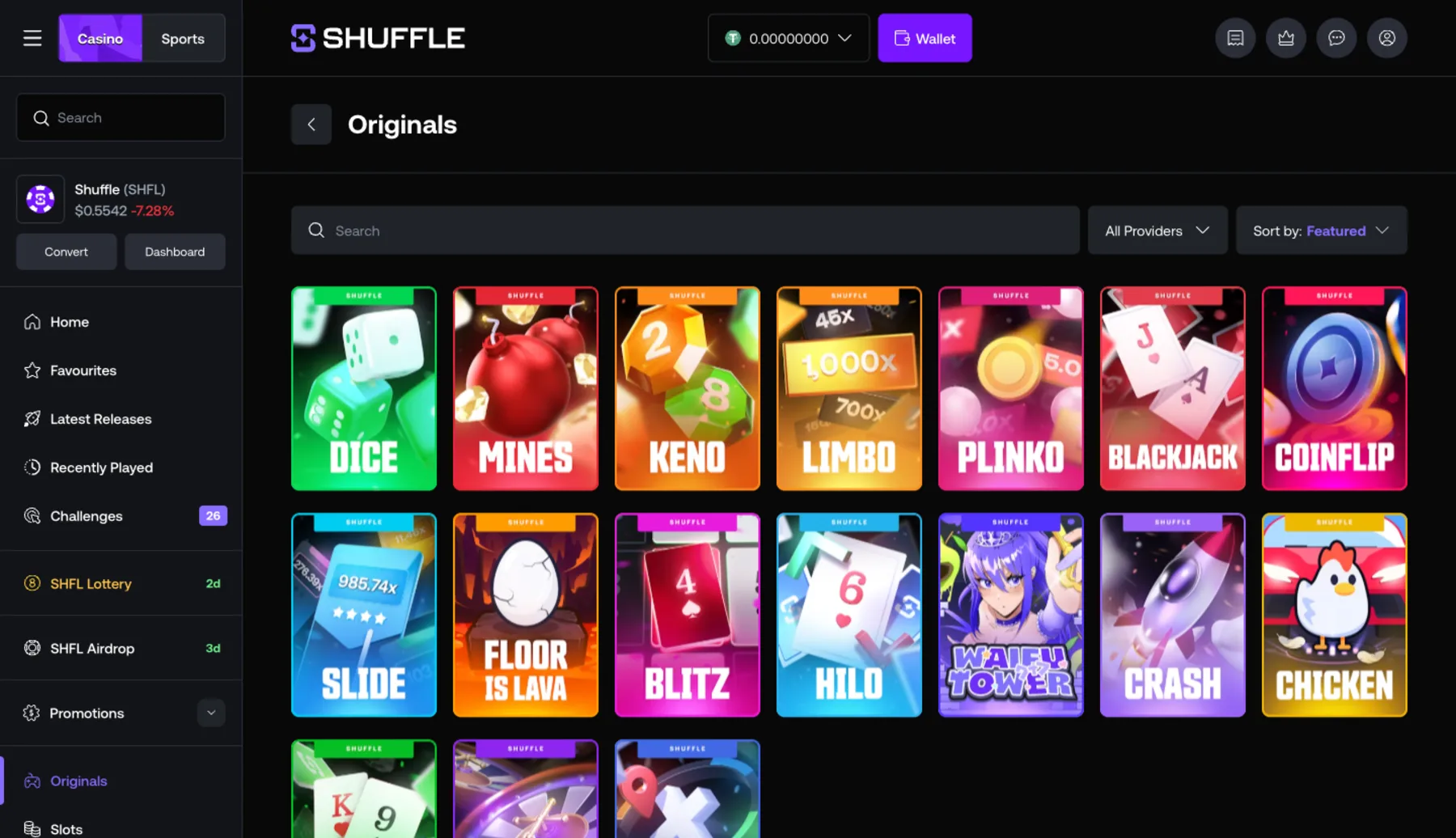
Source: The operator's public catalogue interface, read directly on . Figures are the edge field returned for each title, converted to return to player by subtraction. Third-party figures are set by the studio that built the game, not by Shuffle.
No Single Casino RTP Exists
A slot has a return to player because it has fixed maths. A casino has thousands of games with different maths, so a single figure for the venue is meaningless, and any review quoting one has invented it.
What can be published is the margin on each title, and that is what Shuffle does. Its catalogue interface returns an edge value for every game, and subtracting that from 100% gives the theoretical return.
RTP Across the In-House Games
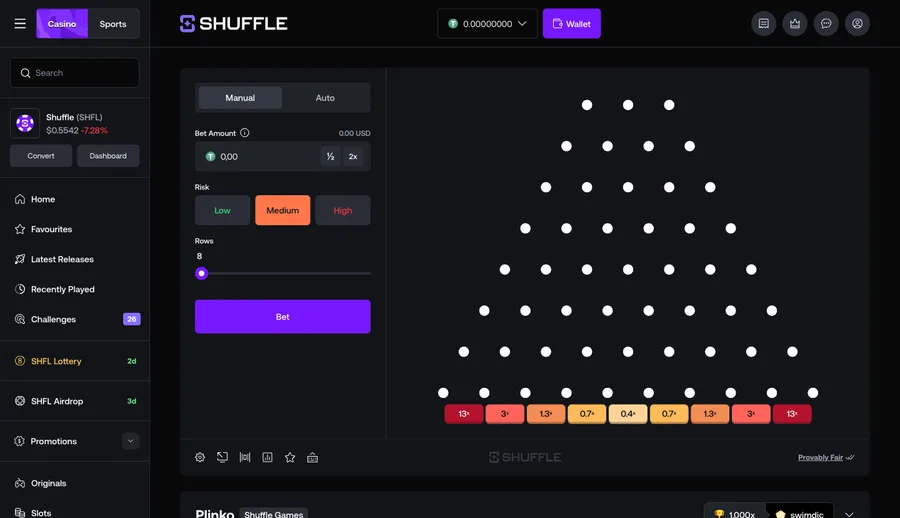
Seventeen titles are built by the operator, and their margins cluster tightly. Blackjack is the outlier at 0.52%, a 99.48% return. Eight games sit at 1%, Baccarat at 1.06%, six games at 2%, and Roulette carries the heaviest margin at 2.7%.
For a player the useful comparison is cost per hour rather than the decimal itself. Staking $100 across Blackjack costs 52 cents in theory; the same $100 across Roulette costs $2.70. Both are small against variance in any single session, and both are the price of admission over time.
Third-Party RTP Belongs to the Studio
The same interface returns a margin for slots Shuffle did not build, and this is where the number changes meaning. A studio sets the return on its own game, sometimes shipping several versions of one title at different returns, and the casino chooses which to run.
Two examples from the catalogue show the spread: a modern Hacksaw release returning 96.38%, and an older Novomatic title returning 92.28%. A four-point gap between two games in the same lobby is larger than the difference between any two Originals, which is the practical argument for checking the figure per game rather than trusting a category.
How RTP Changes Bonus Wagering
Shuffle does not use the standard contribution table where slots count 100% and live games count 10%. A stake contributes in proportion to its game's margin, scaled against a 4% benchmark.
The consequence is worth stating plainly, because it inverts normal advice: the worse a game's return, the faster it clears a bonus. Roulette at 2.7% contributes about $67.50 per $100 staked, while Blackjack at 0.52% contributes about $13. Clearing a bonus on the cheapest games in the lobby is the slowest route through it, and because every edge is published, the trade-off is arithmetic rather than guesswork.
What an RTP Figure Cannot Tell You
A theoretical return describes an average over a very long run, not an evening. Nothing in these numbers predicts a session, and a 99% game can take your balance as efficiently as a 97% one over a hundred spins.
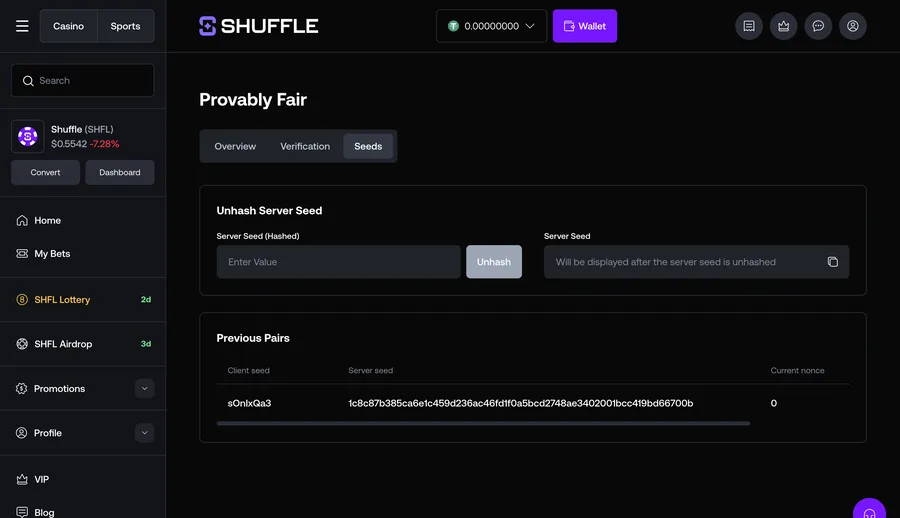
The other limit is scope. These are the operator's published figures, read on one date, and a catalogue changes. We are not treating a margin field as an audited number: it is what the operator states, which is more than most publish and less than an independent test would give.
In-House Returns, by Band
| Band | Titles | House edge | Return to player |
|---|---|---|---|
| Blackjack | 1 | 0.52% | **99.48%** |
| Eight at one percent | 8 | 1% | **99%** |
| Baccarat | 1 | 1.06% | **98.94%** |
| Six at two percent | 6 | 2% | **98%** |
| Roulette | 1 | 2.7% | **97.30%** |
Figures current as of ; the operator's live terms prevail.
What a $100 Stake Costs in Theory
| Game | House edge | Theoretical cost | Bonus contribution |
|---|---|---|---|
| Blackjack | 0.52% | **$0.52** | $13.00 |
| Dice | 1% | **$1.00** | $25.00 |
| Roulette | 2.7% | **$2.70** | $67.50 |
| Sizzling Hot, third-party | 7.72% | **$7.72** | capped by the bonus terms |
Key Terms Used on This Page
- Return to player
- The theoretical share of stakes a game returns over a long run. Shuffle's in-house titles range from 97.30% to 99.48%.
- House edge
- The operator's margin, published per title. Subtracting it from 100% gives the return.
- Contribution
- How much a stake counts toward bonus wagering. Here it is stake multiplied by edge divided by 4%.
- Theoretical cost
- Stake multiplied by edge. $100 through Roulette costs $2.70 in theory; through Blackjack, 52 cents.
- Volatility
- How lumpy returns are. Shuffle publishes no volatility figure for any title.
Deposits and identity checks stay on the operator's own secure site.
Related Reading on This Casino
More on this game, from the same section first:
 Games
GamesThe Originals
17 titles, edge 0.52% to 2.7%
 Games
GamesThe slot library
4,205 slots of a 4,382-game catalogue
 Games
GamesSports betting
55 sports; $500,000 daily win limit
 Games
GamesAlternatives
Four checks settle any crypto casino
 Trust
TrustMobile access
No app; 4,382 games in browser
 Bonuses
The welcome offer
100% to $1,000, 35x, max bet $10
 Trust
TrustLegitimacy
Licence OGL/2024/1337/0628, register-verified
What Else Do Readers Ask?
These are the questions the published margin figures can actually settle.
What is the RTP at Shuffle Casino
No casino-wide RTP exists. Shuffle publishes a house edge per title through its public catalogue, covering in-house and third-party games alike.
Which Shuffle game has the highest RTP
Blackjack, at 0.52% house edge and a 99.48% return, is the highest of the seventeen in-house titles.
Do third-party slots have published RTP
Yes, the catalogue returns a margin for them too, though the studio that built the game sets it rather than Shuffle.
Is a 99% return good
It is high for a casino game, though it describes a long-run average. No return figure predicts what a single session does.
How does RTP affect bonus wagering
Contribution is the stake multiplied by edge divided by 4%, so higher-margin games clear a bonus faster than low-margin ones.
Can players verify these figures
Yes, the operator's public catalogue interface returns the edge field for any title, which is where every number here came from.
Does Shuffle publish volatility
No, the operator publishes no volatility rating. Any high or low label attached to these games comes from a third party.
Are these figures independently audited
They are the operator's published values, read on , not an independent laboratory measurement of live play.