Shuffle Casino Withdrawals: The Rules That Apply
In short: Three clauses govern a Shuffle withdrawal: 10.2 requires the full deposit to be wagered first, 10.7 reserves the right to charge a fee, and 7.2 gives no commitment on timing at all. The advertised sub-minute payout describes the ordinary case, not a promise.
Withdrawal pages usually describe a button. The useful version describes the contract, because that is what decides whether the button works today. Shuffle advertises that 90% of payouts arrive in under a minute, and its own terms disclaim any timing undertaking, and both of those statements are true at the same time.
Note: Six steps, and the first two decide everything. Verification and the deposit wagering rule cause almost every delay readers report, and both can be cleared before you ever request a payout.
Table of contents
The Steps, in Order
Follow these steps in order; each one is a single action with the control it uses.
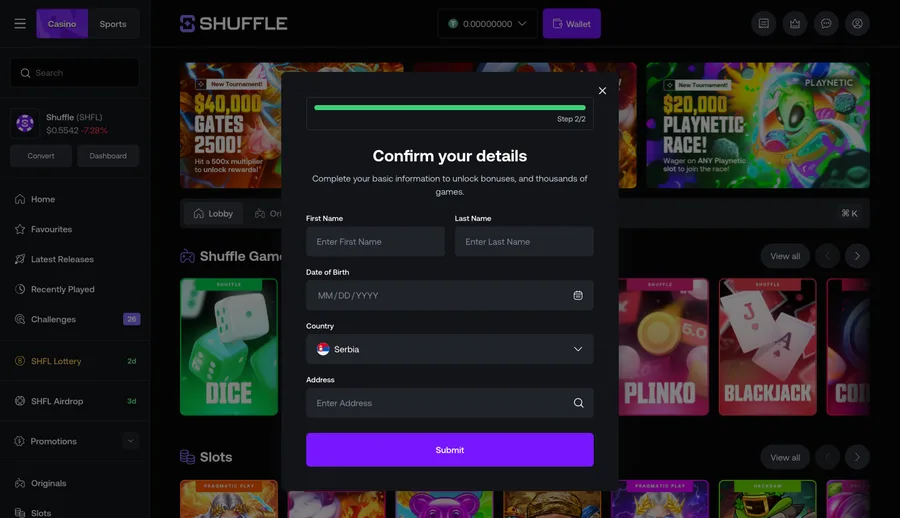
Step 1: Clear the Identity Form First
it gates the cashier, and completing it before you win removes the most common cause of a hold.
Step 2: Check the Deposit Wagering Rule
clause 10.2 requires the full deposit to be wagered before withdrawal, unless the money returns to the same address on the same network.
Step 3: Finish Any Active Bonus
clause 3.7 allows bonuses and the winnings from them to be cancelled where bonus terms are breached, so a part-cleared bonus is not a good moment to withdraw.
Step 4: Match the Network to the Asset
send back on the chain the cashier lists, because a misrouted withdrawal is not something the terms promise to recover.
Step 5: Read the Fee Before Confirming
clause 10.7 reserves the right to charge a withdrawal fee, and the cashier displays the live figure at confirmation.
Step 6: Expect a Review on a First Payout
clause 5.2 permits an identity check with no published threshold, and clause 7.2 sets no deadline for completing it.
Three Clauses Govern a Withdrawal
Clause 10.2 is the one most readers meet first. A deposit must be wagered in full before it can be withdrawn, with a single exception: sending it back to the same address on the same network. Deposit, change your mind, and the money is not simply returnable to a different wallet.
Clause 10.7 reserves the right to charge a withdrawal fee. The operator's blog describes fees as network costs only, but the terms are the document that governs, so a flat claim that Shuffle takes no fee cannot be made.
Clause 7.2 is the one that matters when something goes wrong. It gives no undertaking whatsoever about how long a withdrawal takes. That is not unusual in this industry, and it is the reason a hold can run for weeks without breaching anything.
Why Withdrawal Speed Splits in Two
The storefront says 90% of withdrawals reach the wallet in under a minute. Public feedback is dominated by payouts stuck in review for weeks. These describe different situations and neither is a lie.
The fast path is an account already verified, a modest sum, a familiar network. The slow path is a first withdrawal, or one that triggers a check. Since the operator states there is no fixed dollar threshold that triggers a review, you cannot plan around the boundary, only around the verification that removes the most common reason for one.
Interac Withdrawals for Canadians
The Interac rail runs in both directions: $5 minimum, $10,000 maximum per transaction, no operator fee, with the balance held in dollars. The help centre describes withdrawals as instant to thirty minutes, while the blog says about an hour. Where they disagree we take the help centre, which is the documentation rather than the marketing.
The $10,000 per-transaction ceiling is the only published withdrawal cap anywhere on the site. No daily, weekly or monthly limits are stated for crypto, and no per-coin minimums are published either.
What Our Withdrawal Testing Missed
We opened an account and verified what could be verified without money, which means we have no withdrawal timing of our own to report. We are not borrowing someone else's figures and presenting them as measurement.
What we can report is the shape of the contract, and it is asymmetric. The operator commits to no timing, may charge a fee, may hold for checks with no stated threshold, and caps a Canadian transaction at $10,000. Against that, the fast path is genuinely fast for most people most of the time. Both halves belong in any honest answer.
The Clauses That Govern a Payout
| Clause | What it says | Effect on you |
|---|---|---|
| 10.2 | Deposit must be wagered before withdrawal | A deposit is not freely returnable, except to the same address |
| 10.7 | Operator may charge a withdrawal fee | "No fees" cannot be stated as a guarantee |
| 7.2 | No undertaking on timing | A hold can run indefinitely without breaching the terms |
| 5.2 | ID required before first withdrawal | Verification is the most common cause of delay |
| 3.7 | Bonuses and winnings may be cancelled | Withdrawing mid-bonus carries risk |
Figures current as of ; the operator's live terms prevail.
Interac Withdrawals, the Only Published Limits
| Parameter | Value |
|---|---|
| Minimum | **$5 per transaction** |
| Maximum | **$10,000 per transaction** |
| Operator fee | **None on this rail** |
| Stated timing, help centre | **Instant to 30 minutes** |
| Stated timing, blog | About an hour |
Key Terms Used on This Page
- Deposit wagering
- Clause 10.2's rule that a deposit must be staked in full before withdrawal, unless returned to the same address and network.
- Verification hold
- A pause while identity checks run, permitted by clause 5.2 with no published threshold and no deadline.
- Withdrawal fee
- A charge clause 10.7 permits. The cashier shows the live figure before you confirm.
- Same-network return
- The one exception to deposit wagering: sending funds back to the address they came from, on the same chain.
- Per-transaction cap
- The $10,000 Interac ceiling, the only published withdrawal limit on the site.
Deposits and identity checks stay on the operator's own secure site.
Related Reading on This Casino
More on this game, from the same section first: